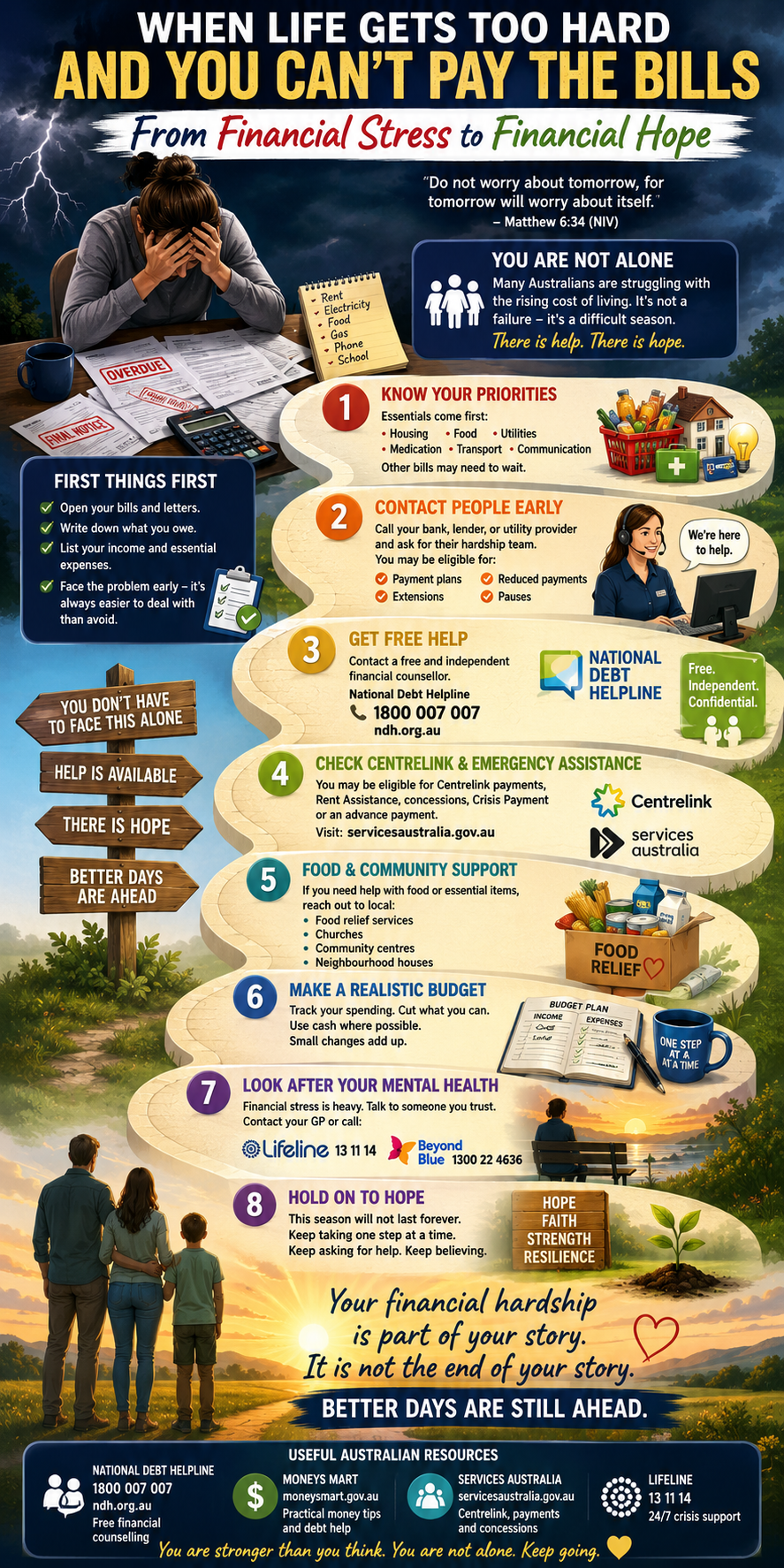
When Life Gets Too Hard – When You Cannot Pay the Bills
When the Money Runs Out Before the Month Does
Note: Almost all of our Articles are written from a Worldwide perspective – because the problems are Worldwide. This one is Australian-Based because of the need for local sources of assistance. For people outside Australia, please look for your location’s help sources.
There are few worries more frightening than not being able to pay the bills.
It is one thing to say, “Money is tight.”
It is another thing entirely to sit at the kitchen table with a stack of unpaid bills, a nearly empty bank account, and no clear idea how you are going to get through the week.
The rent is due.
The electricity bill has arrived.
The grocery shopping costs more than it used to.
The car needs fuel.
The school wants money for an excursion.
The phone bill is overdue.
And somewhere in the middle of it all, when you cannot pay the bills, you are expected to stay calm, keep smiling, and carry on as though everything is fine.
But everything may not feel fine.
In Australia, many people who once felt secure now feel under pressure. Rising rents, mortgage repayments, power bills, groceries, insurance, fuel, medical costs, and everyday expenses have placed enormous strain on households. For many families, pensioners, carers, single parents, workers, and small business owners, the problem is not laziness or poor character. The problem is that life has become expensive, and ordinary people are being stretched beyond what they can reasonably manage.
If that is where you are today, please hear this clearly:
You are not a failure.
You are not alone.
And there are steps you can take.
Financial Stress Is Not a Character Defect
One of the cruellest parts of financial hardship is shame.
People often feel embarrassed when they cannot pay a bill. They hide letters. They avoid phone calls. They stop opening emails. They pretend they are coping because they do not want anyone to know how bad things have become.
But struggling financially does not mean you are irresponsible.
Sometimes life simply becomes too heavy.
A job is lost.
Hours are reduced.
A relationship breaks down.
A landlord increases the rent.
A mortgage rises.
A child gets sick.
A car breaks down.
A business slows.
A partner dies.
A medical bill appears.
One unexpected event can tip an already tight household into crisis.
Financial hardship is not always caused by one big disaster. Sometimes it is caused by a hundred small increases that quietly add up until you reach the state when you cannot pay the bills.
Do Not Ignore the Problem
When bills become overwhelming, the natural reaction is often avoidance.
You may think, “I’ll deal with it tomorrow.”
Then tomorrow comes, and the situation feels even worse.
Avoidance is understandable, but it usually makes things harder. Late fees, disconnection warnings, debt collection letters, and interest can turn a difficult situation into a frightening one.
The first practical step is simple, even if it feels unpleasant:
Open everything.
Write down what you owe.
List the essentials first.
You do not need to solve your entire financial life in one afternoon. You simply need to know what you are dealing with.
A problem you can see is easier to face than a fear hiding in the dark.
When You Cannot Pay the Bills, Start With the Essentials
When there is not enough money to pay everything, priorities matter.
Food, housing, electricity, water, medication, transport to work, and basic communication usually come first.
Credit cards, personal loans, Buy Now Pay Later payments, subscriptions, and non-essential expenses may need to wait.
This does not mean those bills are unimportant. It means survival comes first.
If you are choosing between groceries and a credit card payment, buy food.
If you are choosing between rent and a streaming service, pay the rent.
If you are choosing between medication and an unsecured debt, look after your health.
This is not financial advice for every situation, but it is a reminder that when life becomes urgent, the basics must be protected first.
Contact People Before They Contact You
Many Australians do not realise that banks, lenders, energy companies, phone providers, and other businesses often have hardship teams.
They may be able to offer payment plans, extensions, temporary reduced payments, pauses, or other arrangements.
The Australian Government’s Moneysmart website says that when you ask a lender for hardship assistance, the lender must consider your request and assess what help may be available.
That is important.
You are not begging.
You are using a process that exists for exactly this reason.
When You Cannot Pay the Bills, the hardest phone call is often the first one.
You might say:
“I am experiencing financial hardship and cannot make the full payment by the due date. I want to work out a realistic payment plan.”
Keep notes of every conversation.
Write down the date, the person’s name, what was agreed, and any reference number.
If speaking on the phone feels too stressful, many companies also allow hardship requests by email, online form, or chat.
Get Free Help Before Things Get Worse
One of the best things Australians can do when bills become overwhelming is contact a financial counsellor.
Financial counsellors are not the same as financial planners. They do not sell investment products. They help people in financial difficulty understand their options, deal with debts, speak to creditors, and make a plan.
The National Debt Helpline provides free, independent and confidential financial counselling. The number is 1800 007 007, and its website also provides live chat options.
If you are overwhelmed and do not know where to begin, this can be a powerful first step.
You do not need to have everything organised before you call.
You do not need to know the perfect questions.
You simply need to start.
Electricity, Gas and Water Bills
Power bills can be especially frightening because people fear being disconnected.
If you cannot pay your electricity, gas, or water bill, contact the provider as soon as possible and ask for their hardship team.
Moneysmart recommends speaking to utility providers about hardship arrangements, including paying bills by instalments.
Do not wait until the final warning if you can avoid it.
Ask about:
Payment plans.
Hardship programs.
Concessions.
Bill smoothing.
Extensions.
Energy-saving advice.
Whether you are on the best available plan.
If you receive a Centrelink payment, hold a concession card, or are a pensioner, check whether you are receiving all rebates and concessions available in your state or territory.
Small reductions can matter when every dollar counts.
Centrelink and Emergency Assistance
If your circumstances have changed, check whether you are eligible for Centrelink support, Rent Assistance, Family Tax Benefit, Parenting Payment, JobSeeker, Carer Payment, Age Pension, or other help.
Services Australia also provides information about Crisis Payment, which is a one-off payment for people who have experienced extreme circumstances and are in severe financial hardship.
Some people receiving certain Centrelink payments may also be able to apply for an advance payment, which is repaid over time from future payments. The National Debt Helpline notes that advance payments may be available to some people receiving Centrelink income support or Family Tax Benefit Part A.
This does not mean every person will qualify.
But it does mean it is worth checking.
When You Cannot Pay the Bills, pride can become expensive. If help is available and you are eligible, accept it.
There is no shame in receiving support during a hard season.
Food Comes First
No one should feel ashamed about needing help with food.
Across Australia, churches, charities, community centres, food relief services, and emergency aid organisations help people who are struggling.
Some provide food hampers.
Some provide supermarket vouchers.
Some provide meals.
Some help with bills, transport, clothing, school needs, or emergency accommodation referrals.
If you do not know where to start, search locally for emergency relief, ask a church, contact a community centre, or call the National Debt Helpline for guidance. The Salvation Army is often a good place to start as local help is available nationwide. In addition, you have someone to talk to locally – Support always helps. And the Resource at the bottom of this page is a God-Send! When children are hungry, when cupboards are bare, or when you are skipping meals so others can eat, it is time to ask for help.
That is not weakness.
That is wisdom.
Do Not Let Debt Collectors Frighten You Into Panic
Debt collection letters can be intimidating.
They are designed to get your attention.
But panic rarely leads to good decisions.
Do not agree to payments you cannot afford just because someone pressures you.
Do not borrow from a payday lender simply to silence another creditor.
Do not take out new debt without understanding the consequences.
Do not ignore legal documents.
If a debt collector contacts you, stay calm. Ask for details in writing. Confirm the debt. Contact a financial counsellor before making promises you cannot keep.
The Australian Financial Security Authority also points people struggling with debt toward the National Debt Helpline for free, independent and confidential support.
You have more options than you may realise.
Beware of Quick-Fix Loans
When you are desperate, fast money can look like rescue.
But payday loans, high-interest credit, Buy Now Pay Later stacking, and borrowing to pay borrowing can make the situation worse.
A small emergency loan can become months of stress.
A missed payment can lead to fees.
A temporary fix can become a long-term trap.
Before taking on more debt, ask:
Will this actually solve the problem?
Can I afford the repayments?
What happens if another bill arrives?
Is there a safer option?
Have I spoken to a free financial counsellor first?
When life feels urgent, slow decisions are often safer than fast ones.
Talk to Someone You Trust When You Cannot Pay the Bills
Financial pressure can become deeply lonely.
You may feel embarrassed to tell anyone.
But secrecy can increase stress.
Choose one safe person.
A family member.
A friend.
A pastor.
A support worker.
A counsellor.
A trusted neighbour.
You do not need to tell everyone. But telling someone can reduce the emotional weight.
Sometimes the person cannot fix the problem, but they can sit with you, help you make calls, organise paperwork, mind the children, cook a meal, or remind you that your life is worth more than your bank balance.
Your Worth Is Not Measured by Your Bank Account
When bills pile up, people often begin to feel worthless.
They think:
“I should be doing better.”
“I have let my family down.”
“I am a burden.”
“I will never recover.”
But money trouble does not define your value.
Your unpaid electricity bill is not your identity.
Your overdue rent is not your character.
Your credit card balance is not your future.
You are still a person of worth.
You are still loved.
You still matter.
This is a hard chapter, not the whole story.
Finding Hope When the Numbers Don’t Add Up
One of the hardest things about financial hardship is that it can make tomorrow seem frightening.
You lie awake wondering how the next bill will be paid.
You mentally add and subtract the same numbers over and over again, hoping the answer will somehow change.
You promise yourself that next week will be easier.
Then another unexpected expense arrives.
Many Australians know exactly what that feels like.
The important thing to remember is this:
Financial hardship is usually temporary.
It may not feel temporary today.
It may last weeks, months, or even longer.
But very few people remain in exactly the same circumstances forever.
Jobs change.
Businesses recover.
Children grow up.
Expenses reduce.
New opportunities appear.
The future has a remarkable way of surprising us.
When You Cannot Pay the Bills – Create a Budget You Can Actually Live With
Many people dislike the word “budget.”
It sounds restrictive.
It sounds complicated.
But a budget is simply a plan for your money.
It tells every dollar where it needs to go before it disappears.
You don’t need expensive software.
A simple notebook or spreadsheet is often enough.
Start by writing down:
- Your total weekly or fortnightly income.
- Essential expenses such as housing, food, utilities, medication and transport.
- Minimum repayments on debts.
- Any regular subscriptions.
Be completely honest.
The budget isn’t there to judge you.
It is there to help you regain control.
If the numbers don’t balance, don’t panic.
That simply tells you changes are needed.
Every small saving helps.
Making your lunch instead of buying it.
Shopping with a list.
Comparing supermarket specials.
Reducing takeaway meals.
Cancelling subscriptions you rarely use.
Using public transport where practical.
None of these changes will make you wealthy overnight.
But together they can make a meaningful difference.
More importantly, they help you feel that you are taking control rather than being controlled by your finances.
Teach Children Without Burdening Them
Children are remarkably observant.
Even if you never discuss money, they often sense when something is wrong.
They notice your stress.
They hear conversations.
They see changes in spending.
The goal isn’t to hide reality.
Neither is it to place adult worries on young shoulders.
Simple, age-appropriate honesty usually works best.
You might say:
“We’re being careful with our money at the moment, so we’re choosing to spend less for a while.”
Children usually cope much better with truthful reassurance than with unexplained tension.
You don’t have to pretend everything is perfect.
You simply need to let them know they are loved and safe.
Many adults later remember difficult financial times with surprisingly positive memories because their parents protected them with love rather than expensive possessions.
Don’t Lose Sight of the Bigger Picture
Financial hardship has a way of shrinking your world.
Everything becomes about money.
Every decision.
Every conversation.
Every worry.
But life is still much bigger than your bank account.
A walk along the beach.
Watching a sunset.
Playing a board game.
Reading together.
Visiting a park.
Sharing a laugh.
Calling an old friend.
Listening to music.
Many of life’s greatest joys cost very little.
Never let financial pressure rob you of every good moment.
Even during difficult seasons, there are still reasons to smile.
When You Cannot Pay the Bills, Beware of Hopeless Thinking
Money problems often create dangerous thought patterns.
“I’ll never get out of this.”
“Nothing ever changes.”
“I’m always going to struggle.”
“My family would be better off without me.”
These thoughts feel convincing because stress changes the way we think.
But feelings are not facts.
Thousands of Australians have faced overwhelming debt and eventually rebuilt their lives.
Some found better employment.
Some downsized.
Some started businesses.
Some received unexpected opportunities.
Some simply kept putting one foot in front of the other until life gradually improved.
Your circumstances today are real.
They are not necessarily permanent.
There Is No Shame in Starting Again
Many successful Australians have experienced financial collapse.
Businesses have failed.
Homes have been sold.
Savings have disappeared.
People have declared bankruptcy.
Yet many rebuilt lives that became stronger than before.
History is filled with people who lost almost everything before beginning again.
Failure isn’t always the end.
Sometimes it is the beginning of a different and better chapter.
Starting over takes courage.
But courage grows one decision at a time.
Protect Your Mental Health
Money worries affect much more than your wallet.
They affect sleep.
Relationships.
Physical health.
Confidence.
Hope.
If you find yourself constantly anxious, unable to sleep, withdrawing from others, or losing interest in life, please don’t ignore those signs.
Speak with your GP.
Talk with someone you trust.
Reach out to a counsellor.
If you feel overwhelmed, Australia has confidential services such as Lifeline (13 11 14) and Beyond Blue (1300 22 4636), where trained people are available to listen.
You were never meant to carry every burden alone.
Asking for help is one of the bravest decisions a person can make.
If You Have Faith, Lean Into It
Financial hardship appears throughout the Bible.
Many faithful people experienced seasons of uncertainty.
Yet again and again we find a God who cares for ordinary people facing difficult circumstances.
Jesus reminded His followers:
“Therefore do not worry about tomorrow, for tomorrow will worry about itself.” — Matthew 6:34 (NIV)
That does not mean we ignore today’s responsibilities.
It means we do not allow tomorrow’s fears to consume today’s strength.
Another beautiful promise says:
“And my God will meet all your needs according to the riches of his glory in Christ Jesus.” — Philippians 4:19 (NIV)
God’s provision does not always arrive in the way we expect.
Sometimes it comes through a new job.
Sometimes through wise advice.
Sometimes through generous friends.
Sometimes through a church or charity.
Sometimes through unexpected opportunities.
Sometimes simply through the strength to keep going one more day.
Faith doesn’t remove every financial challenge.
But it reminds us that we never face those challenges alone.
Keep Looking for Small Victories
When life becomes overwhelming, we often overlook progress because it seems too small.
Celebrate every victory.
A bill paid.
A debt reduced.
A successful payment arrangement.
A cheaper insurance policy.
A better electricity plan.
An extra shift at work.
A successful job interview.
A growing emergency fund, even if it begins with only twenty dollars.
Small victories eventually become major turning points.
Financial recovery rarely happens in one giant leap.
It usually happens through hundreds of wise decisions made over many months.
Better Days Really Do Come
If you had asked many people five years ago whether their lives would improve, they might have answered “No.”
Today many of those same people own homes again.
Others have steady employment.
Some have paid off debt.
Others have started successful businesses.
Many simply learned how resilient they really were.
Life has a remarkable ability to change.
So do people.
Don’t underestimate what can happen over the next year.
Or the next five years.
The chapter you’re living now is not necessarily the chapter you’ll be living then.
Final Thoughts
When You Cannot Pay the Bills today, remember this:
You are far more valuable than the numbers in your bank account.
Money comes and goes.
Circumstances change.
Economies rise and fall.
But your worth remains constant.
There is no shame in asking for help.
There is no shame in accepting support.
There is no shame in starting again.
The strongest people are not those who never struggle.
They are those who refuse to let struggle have the final word.
Take one step today.
Make one phone call.
Open one letter.
Prepare one budget.
Ask one trusted person for help.
Cook one simple meal.
Apply for one job.
Contact one financial counsellor.
One small action may become the beginning of a completely different future.
And above all, don’t lose hope.
Some of the happiest, wisest and most compassionate people you will ever meet are people who once wondered how they would pay the next bill.
They discovered something that money can never buy.
They discovered resilience.
They discovered courage.
They discovered gratitude.
And they discovered that hope has a remarkable way of growing, even in the hardest seasons.
If today feels impossibly heavy, keep going.
Tomorrow may not solve every problem.
But it brings new opportunities, fresh mercies, unexpected kindness, and possibilities that simply do not exist today.
One day you may look back on this difficult season and realise that although you would never choose to live through it again, it taught you strength you never knew you possessed.
Your current financial hardship is part of your story.
It is not the end of your story.
Keep believing.
Keep planning.
Keep asking for help when you need it.
Keep moving forward.
Because better days really are ahead.
IMPORTANT RESOURCE
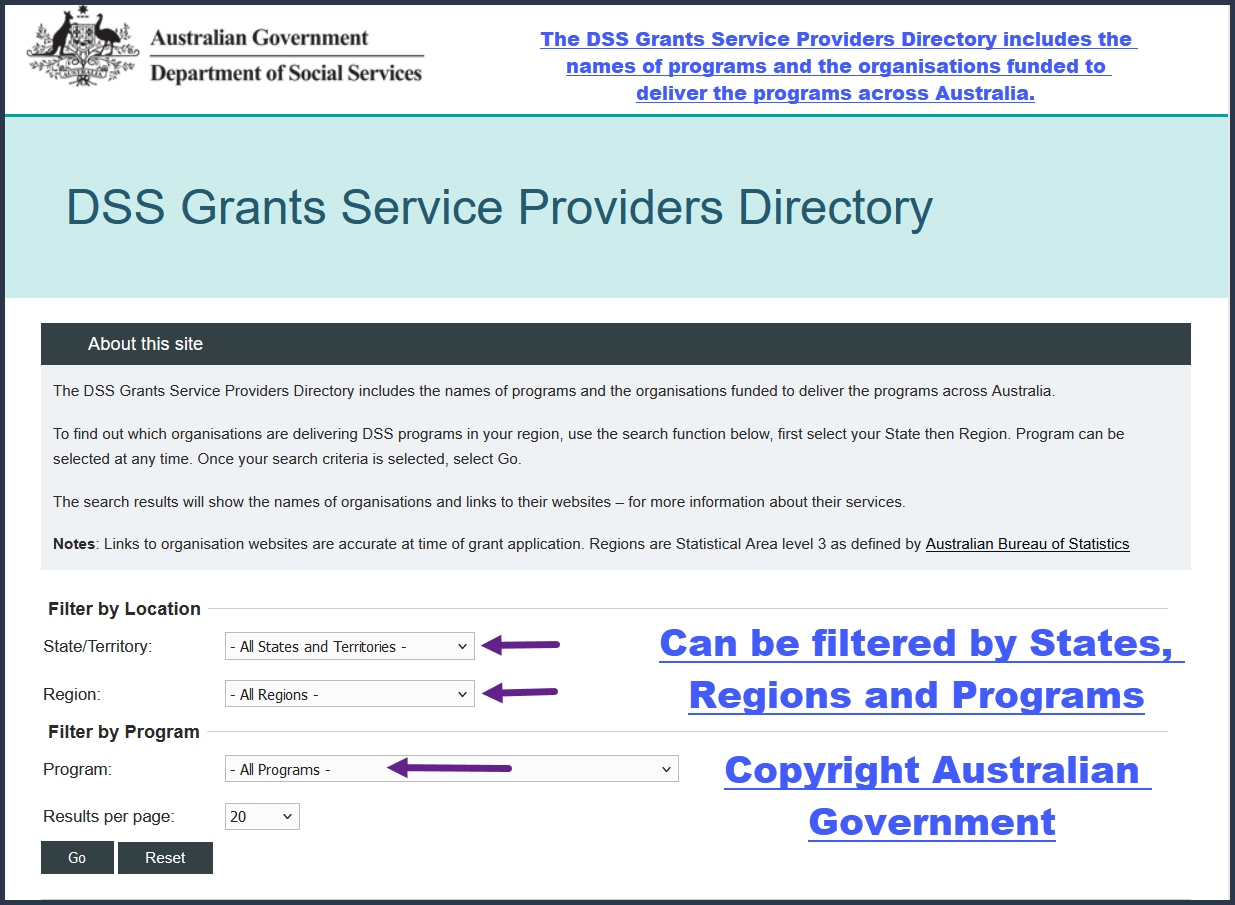
Check Out:
https://serviceproviders.dss.gov.au/
This is a Vital Resource Australia-Wide.
It goes beyond the issues mentioned here. For example, it covers all of the financial issues mentioned in this Report – But goes beyond them.
For example, if you are just surviving but cannot afford to replace a car that is becoming unroad-worthy … Check out if you qualify for a NILS Loan – “No Interest Loan Service.”
It also covers problems like Mental Health Assistance, Councelling, Parenting Assistance, Organisations like the Salvation Army, St. Vincents, Lifeline, Save the Children, Church Based Charities, The Smith Family, Relationships Australia and much, much more!
Thank you for Reading our Article on When You Cannot Pay the Bills