An Article on When Life Gets Too Hard at Work – With Some Suggested Solutions!
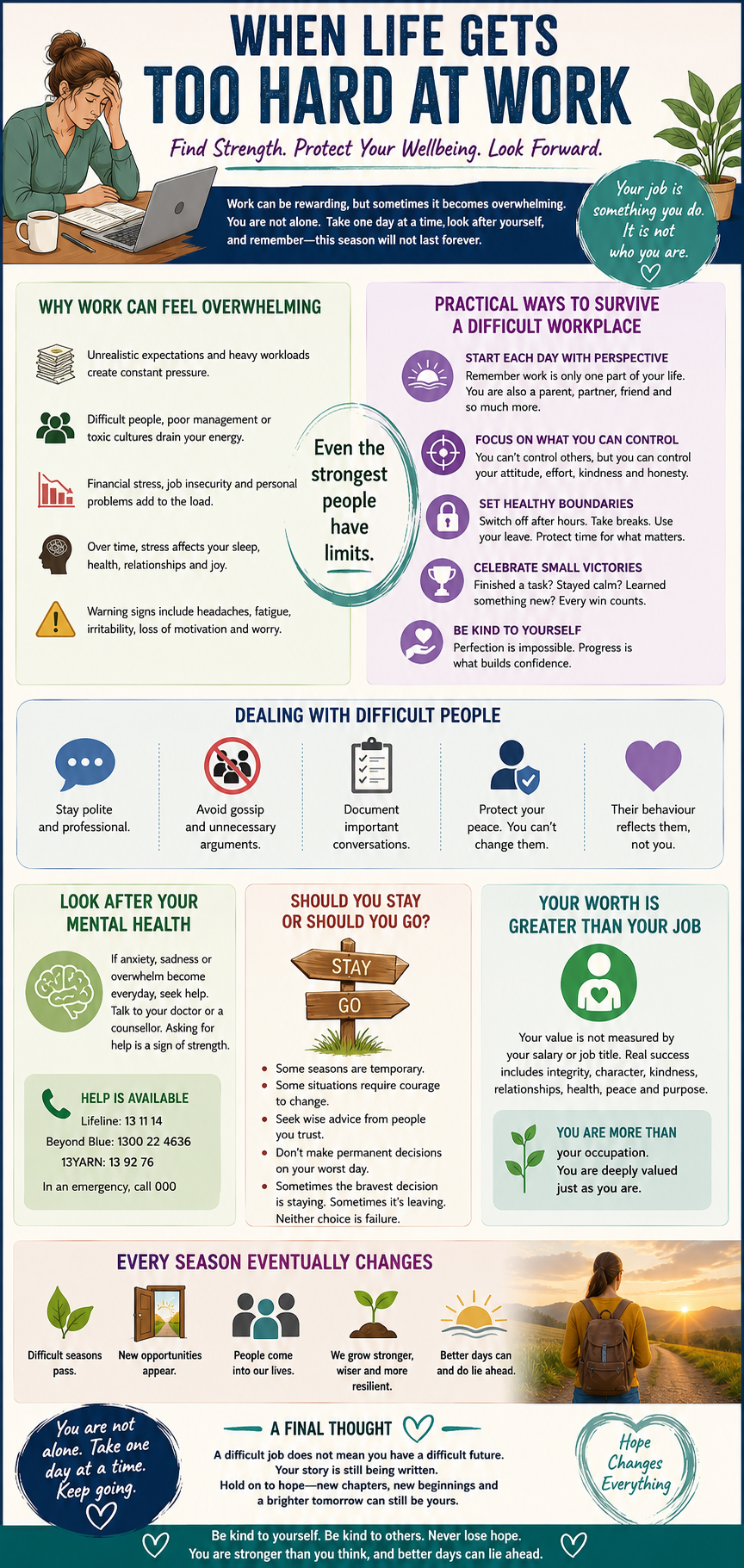
When Life Gets Too Hard at Work
Part 1: When the Place That Pays the Bills Begins to Break Your Spirit
Most of us spend a large part of our lives at work. For many people, it is more than simply earning a wage. Work provides routine, purpose, friendships, achievement, and the satisfaction of contributing to something worthwhile. It helps pay the mortgage, support a family, fund holidays, and build the future we hope for.
But what happens when the very place that is meant to provide security becomes the source of our greatest stress?
There are seasons when going to work feels like climbing a mountain every single day. The alarm clock rings, and instead of feeling motivated, your stomach tightens. You begin counting the hours before you even leave home. Sunday evenings become miserable because Monday is approaching. You may lie awake worrying about tomorrow’s meeting, your impossible workload, or the difficult person you know you will have to face.
If that describes you, you are certainly not alone.
Thousands of Australians quietly struggle through difficult workplaces every day. Some feel overwhelmed by unrealistic expectations. Others deal with bullying, poor management, financial uncertainty, toxic colleagues, or constant fear that their position may disappear. Some simply feel trapped in jobs they no longer enjoy but cannot afford to leave.
Work can become so emotionally exhausting that it begins affecting every other part of life. Home is no longer a refuge because work follows you there through emails, phone calls, and endless worrying. Relationships become strained. Sleep becomes difficult. Physical health suffers. Joy slowly disappears.
Yet no matter how difficult today may seem, it is important to remember one simple truth:
Your job is something you do. It is not who you are.
That distinction can change everything.
Why Work Can Feel So Overwhelming
Stress at work rarely comes from one single event. It usually develops slowly over time.
Perhaps the business has reduced staff, leaving fewer people to do more work. Deadlines become tighter. Expectations continue to rise while support decreases.
Maybe a new manager arrives with a completely different leadership style. Suddenly, the workplace culture changes. Trust disappears. Communication becomes poor. Employees feel like numbers instead of people.
Sometimes the problem is not the work itself but the people.
Most workplaces include wonderful colleagues who make difficult days easier. Unfortunately, some also include individuals who criticise constantly, spread gossip, take credit for other people’s efforts, or seem determined to create conflict wherever they go.
Working alongside negativity every day is exhausting.
Other people experience the opposite problem.
Their workplace is simply relentless.
Every day feels like running on a treadmill that keeps increasing its speed. There is always another deadline, another customer, another problem, another crisis.
Eventually the body begins sending warning signs.
Headaches become frequent. Sleep becomes difficult. You become impatient over small issues.
You lose enthusiasm for things you once enjoyed. You begin wondering whether you can keep going.
These warning signs should never be ignored.
The Hidden Cost of Carrying Everything Alone
Many people suffer silently because they believe admitting they are struggling somehow means they are weak.
Nothing could be further from the truth.
Even the strongest people have limits.
Imagine carrying a backpack.
On the first day, someone places one brick inside. It feels manageable.
The next day another brick is added.
Then another. And another.
After weeks or months, the backpack becomes incredibly heavy.
People looking from the outside may wonder why you are struggling.
What they cannot see is how many bricks you have been carrying.
Financial pressure.
Family responsibilities.
Ageing parents.
Health concerns.
Relationship problems.
Job insecurity.
A difficult manager.
Long hours.
None of these alone may seem overwhelming.
Combined together, they can feel crushing.
There is enormous strength in recognising when the backpack has become too heavy to carry by yourself.
Be Careful Who You Compare Yourself To
Modern workplaces often encourage unhealthy comparison.
Someone receives a promotion. Someone else buys a bigger house.
A colleague seems endlessly confident. Another employee appears to handle impossible workloads with ease.
Social media makes this even worse.
People proudly share stories of promotions, awards, overseas conferences, expensive holidays, and career achievements.
Very few post photographs showing panic attacks before work or tears in the staff car park.
We compare our behind-the-scenes struggles with everyone else’s highlight reel.
It is an unfair comparison.
Every person is enduring battles you cannot see.
Success on the outside does not always reflect peace on the inside.
Some highly paid executives experience enormous anxiety.
Some respected professionals battle depression.
Some business owners lie awake worrying whether they can pay their employees next month.
Appearances rarely tell the whole story.
Instead of comparing yourself with others, compare yourself with who you were yesterday.
Small improvements matter.
Perfection Is an Impossible Employer
Many hardworking people become their own harshest critic.
Nothing is ever good enough.
Every mistake feels catastrophic.
Every criticism is taken personally.
Every achievement is quickly forgotten because attention immediately shifts to the next task.
Perfectionism creates a finish line that continually moves further away.
The problem is not working hard.
The problem is believing that your worth depends upon never making mistakes.
Nobody succeeds all the time.
Every experienced professional has made poor decisions.
Every successful business owner has experienced failures.
Every respected leader has made mistakes they wish they could change.
Growth always includes failure.
If your workplace expects perfection, it is asking for something no human being can deliver.
If you expect perfection from yourself, perhaps it is time to replace perfection with progress.
Progress builds confidence.
Perfection destroys it.
The Difference Between Pressure and Purpose
Pressure tells you: “You must do more.”
Purpose reminds you: “What I’m doing matters.”
Two people can perform exactly the same job while experiencing completely different emotions.
One feels trapped. The other feels fulfilled.
The difference is often found in purpose.
A cleaner may simply mop floors.
Or they may create a clean environment that protects patients in a hospital.
A teacher does more than deliver lessons.
They shape future generations.
A truck driver does more than transport freight.
They keep supermarkets stocked and communities supplied.
Even ordinary work has extraordinary value when viewed through a different lens.
Finding purpose does not remove pressure.
But it helps explain why continuing is worthwhile.
You Cannot Pour from an Empty Cup
One of the greatest workplace myths is that working longer automatically produces better results.
Sometimes it does. Often it doesn’t.
Exhaustion reduces concentration.
Fatigue increases mistakes.
Stress lowers creativity.
Burnout destroys motivation.
You were never designed to work without rest.
Rest is not laziness.
Rest is maintenance.
Professional athletes understand this. Muscles grow stronger during recovery, not during exercise.
Our minds work much the same way.
Taking regular breaks. Sleeping properly.
Walking outside during lunch.
Switching off work emails after hours whenever possible.
Spending time with family.
Laughing. Reading. Gardening.
Fishing. Praying. Enjoying hobbies.
These are not wasted hours.
They are investments in your ability to keep going.
Far too many people wait until complete exhaustion before allowing themselves permission to rest.
By then, recovery often takes much longer.
Looking Ahead
Sometimes the healthiest decision is not learning to cope with a difficult workplace – it is recognising when it is time to move on. Knowing the difference requires wisdom, courage, and careful thought.
Finding Hope, Protecting Your Wellbeing, and Looking Forward
One of the hardest questions anyone can face is this:
“Should I stay, or should I leave?”
There is rarely an easy answer.
Some difficult periods at work are temporary. A stressful project ends. A new manager settles into the role. The business recovers from financial pressure. Relationships improve with time and honest communication.
Other situations are very different.
If your workplace is damaging your physical health, destroying your confidence, or affecting your relationships with your family, it may be time to ask whether the cost has become too high.
Only you can make that decision, but it deserves careful thought rather than an emotional reaction.
Whenever possible, avoid making major career decisions in the middle of your worst day.
Exhaustion often clouds judgement.
Instead, seek wise advice. Talk with trusted family members, close friends, mentors, or professional counsellors. They may see possibilities that are difficult to recognise when you are overwhelmed.
Sometimes the bravest decision is staying.
Sometimes the bravest decision is leaving.
Neither choice is a sign of failure.
Practical Ways to Survive a Difficult Workplace
Although you cannot control every situation at work, you can control many of your responses.
Small changes often make a remarkable difference over time.
Start Each Day with Perspective
Before opening your emails or answering your phone, remind yourself that your job is only one part of your life.
You are also a husband or wife, a parent, a grandparent, a friend, a neighbour, a volunteer, or someone who makes a difference in countless unseen ways.
Do not allow one difficult workplace to define your entire identity.
Focus on What You Can Control
Many people become exhausted worrying about things completely outside their control.
You cannot control:
- Other people’s attitudes.
- Company decisions.
- The economy.
- Office politics.
- Every customer’s behaviour.
You can control:
- Your honesty.
- Your attitude.
- Your preparation.
- Your professionalism.
- Your kindness.
- Your willingness to learn.
When you focus your energy on the things you can influence, life becomes much less overwhelming.
When you concentrate on being nice to others … It is amazing how they suddenly start being nice to you!
Learn to Set Healthy Boundaries
Technology has made it possible to work almost anywhere.
Unfortunately, many people now work almost everywhere.
Emails arrive during dinner.
Messages appear late at night.
Weekends become extensions of the working week.
Unless your role genuinely requires constant availability, it is healthy to establish boundaries.
Turn notifications off after hours.
Take annual leave.
Use your lunch break.
Spend uninterrupted time with people you love.
The world rarely falls apart because someone waited until tomorrow morning to answer an email.
Celebrate Small Victories
Some days, simply getting through the day is an achievement.
Finished a difficult project?
Celebrate.
Handled an unhappy customer professionally?
Celebrate.
Learned a new skill?
Celebrate.
Stayed calm during a stressful meeting?
Celebrate.
Life is not only about reaching huge milestones.
It is built from thousands of small victories that gradually strengthen confidence.
When the Problem Is a Difficult Person
Almost everyone encounters difficult people during their working life.
Some complain constantly.
Some criticise everything.
Some enjoy creating conflict.
Some seem determined to make other people miserable.
Trying to change them usually leads to frustration.
Instead, protect your own peace.
Remain polite.
Remain professional.
Avoid unnecessary arguments.
Document important conversations if required.
Do not join gossip.
Remember that another person’s behaviour says far more about them than it does about you.
One unpleasant individual should never be allowed to steal your joy or destroy your character.
When Work Begins Affecting Your Mental Health
There is an important difference between having a stressful week and experiencing ongoing emotional distress.
If you notice that anxiety, depression, panic attacks, or overwhelming sadness are becoming part of everyday life, do not ignore the warning signs.
Speaking with your doctor is not admitting defeat.
Neither is talking with a psychologist or counsellor.
Just as we seek medical treatment for a broken arm, there is wisdom in seeking help when emotional burdens become too heavy to carry alone.
Australia has excellent mental health professionals and support services available.
Asking for help demonstrates courage, not weakness.
The earlier support is sought, the easier recovery often becomes.
Sometimes a New Beginning Is the Best Decision
History is full of people whose greatest success only came after leaving a difficult workplace.
Some started businesses they had only dreamed about.
Others discovered careers far better suited to their personalities and talents.
Some returned to study.
Some accepted positions with organisations that valued their experience.
Many later looked back and realised that losing one opportunity opened the door to something far better.
That does not mean changing jobs is always easy.
It often involves uncertainty.
But uncertainty is not always the enemy. Sometimes it is the beginning of something wonderful.
Your Worth Is Greater Than Your Pay Packet
Income matters.
We all need to earn a living.
But your value as a human being can never be measured by your salary, your job title, or the size of your office.
Some of the happiest people earn modest incomes.
Some of the wealthiest people feel desperately empty.
Real success includes much more than financial achievement.
It includes integrity.
Character.
Kindness.
Relationships.
Health.
Peace.
Purpose.
These are treasures that no redundancy, recession, or difficult employer can ever take away.
Every Season Eventually Changes
One of life’s greatest encouragements is that nothing stays exactly the same forever.
Difficult seasons pass.
Companies change.
Managers retire.
Children grow older.
Opportunities appear unexpectedly.
Doors that seemed permanently closed suddenly open.
Think back over your own life.
There were probably times when you believed a difficult situation would never end.
Yet somehow it did.
This season will also change.
It may take longer than you would like.
It may happen differently than you expected.
But change is one of life’s few certainties.
Never make permanent decisions based solely on temporary circumstances.
When Life Gets Too Hard at Work – Choosing Hope Instead of Despair
When work becomes overwhelming, it is easy to believe that life will always feel this difficult.
That is rarely true.
Hope is not pretending that problems do not exist.
Hope is believing that today’s problems do not have the final word.
It reminds us that tomorrow brings new opportunities.
Another interview.
Another conversation.
Another idea.
Another chance.
Another beginning.
No matter how difficult your current workplace may be, your story is still being written.
A Final Thought on When Life Gets Too Hard at Work
If work has become one of the hardest parts of your life, know this: You are not alone.
Many people sitting beside you in meetings, standing with you in lunchrooms, or passing you in the corridor are carrying burdens you cannot see.
Be kind to yourself.
Be kind to others.
Take one day at a time.
Ask for help when you need it.
Protect your health.
Value your family.
Never confuse your occupation with your identity.
Most importantly, never lose hope.
A difficult job does not mean you have a difficult future. There are new opportunities yet to discover, new skills yet to learn, new people yet to meet, and new chapters waiting to be written.
One day you may look back on this season and realise that, difficult as it was, it taught you resilience, wisdom, compassion, and strength that could have been learned no other way.
Life may feel incredibly hard at work today.
But today is not forever.
Keep going.
Better days really can lie ahead.
That you for reading our Article on When Life Gets Too Hard at Work – We hope it helped a little.
Please Click Here to Return to the Home Page and GET YOUR FREE BOOK