Spending Time in Prison – Reinventing Yourself
Spending Time in Prison – Reinventing Yourself
“The strongest people are not always those who have never failed, but those who decide their failure will not define the rest of their lives.”
Introduction
Few experiences in life are as confronting as spending time in prison. Whether a sentence is measured in months or years, the loss of freedom, separation from family, strict routines, and daily challenges can leave people feeling hopeless about the future.
Many inmates spend countless hours thinking about the mistakes that brought them there. Some become angry. Others become depressed. Some blame everyone except themselves. Sadly, many leave prison exactly as they entered—only older, more frustrated, and less prepared for life outside.
But it does not have to be that way.
History is filled with men and women who used difficult circumstances—including prison—to completely reinvent themselves. They made a decision that although they could not change yesterday, they could change tomorrow. They chose to use their sentence as an opportunity to become better rather than bitter.
Prison can never erase the consequences of past actions. Society expects people to accept responsibility for their behaviour. However, prison can also become a place where genuine change begins.
Every day behind bars presents a choice.
You can simply count the days until your release.
Or you can make every day count.
If you eventually return to society—and most prisoners do—you will take with you whatever you have built during your time inside. If you have invested in yourself, your future can look very different from your past.
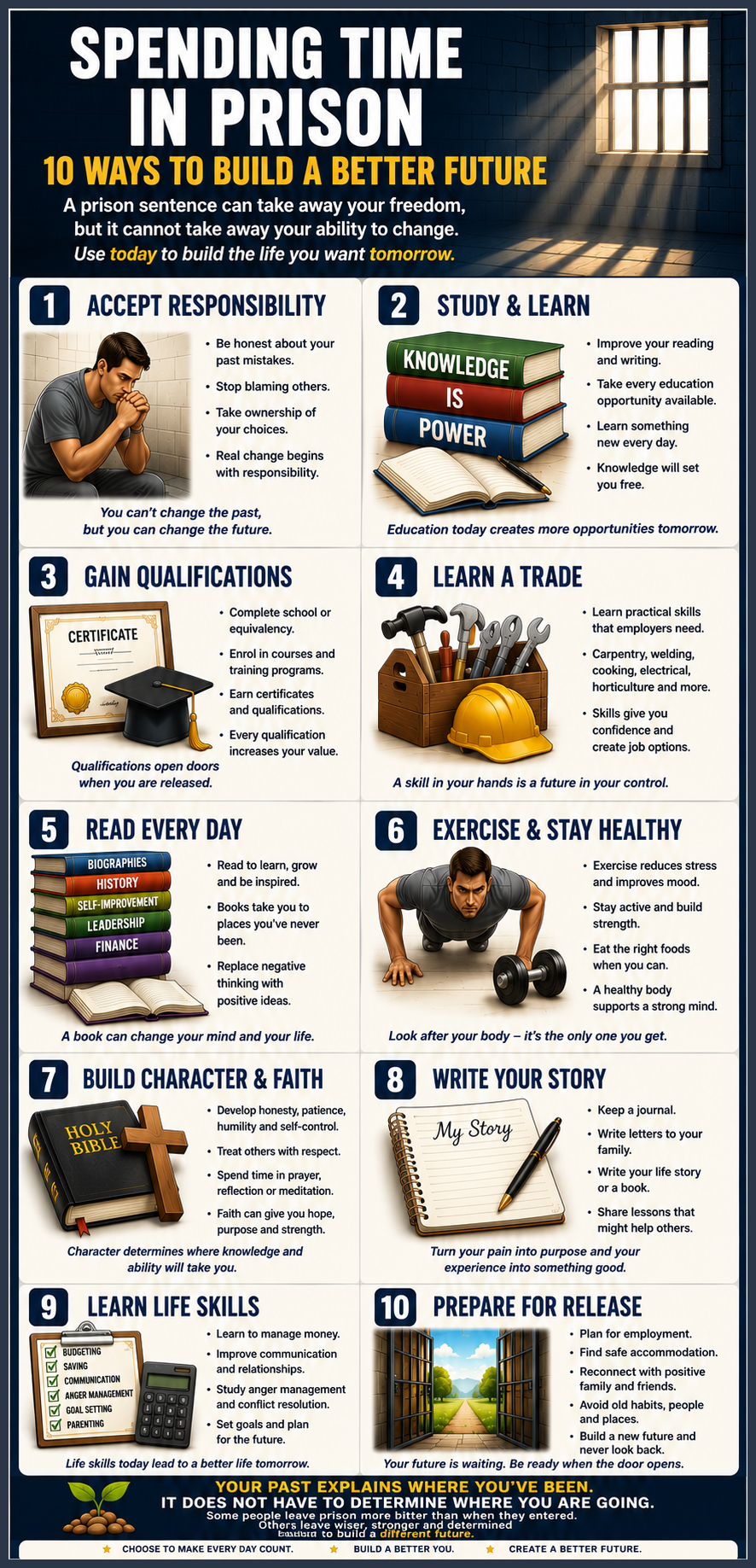
Here are ten positive ways to use your time in prison to prepare for a better life.
Accept Responsibility and Decide to Change
Real change begins with honesty.
It is tempting to blame other people, difficult circumstances, bad friends or bad luck. While life is not always fair, lasting change usually begins when we acknowledge our own choices and accept responsibility for them.
Accepting responsibility is not about endlessly punishing yourself with guilt. It is about recognising that if your choices helped create today’s problems, better choices can help create a better tomorrow.
The past cannot be rewritten.
The future has not yet been written.
Your sentence can become the beginning of a new chapter rather than the final chapter of your story.
Invest in Education
Education is one of the greatest gifts you can give yourself.
Many correctional facilities provide opportunities to improve literacy, complete secondary education, study vocational courses or even undertake university studies through distance education.
Every qualification earned while in prison increases your opportunities after release. If potential employers see you used your time in prison to improve yourself, you chances of employment increase dramatically!
Even if formal courses are unavailable, reading books every day can dramatically increase your knowledge.
Develop a habit of learning.
Knowledge is one thing that no one can take away from you.
Learn a Trade or Practical Skill
Many prisons offer vocational training in areas such as:
-
- Carpentry
- Metal fabrication
- Horticulture
- Painting
- Commercial cleaning
- Hospitality
- Cooking
- Warehousing
- Computer skills
- Maintenance trades
Learning practical skills provides confidence as well as employability.
Employers are often looking for reliable workers who possess practical abilities and a willingness to learn.
When combined with honesty and determination, vocational skills can become the foundation of a completely new career.
Read Every Day
Successful people are almost always lifelong readers.
Books allow you to learn from people you may never meet.
You can study history, psychology, business, finance, communication, leadership, health, philosophy, biographies and countless other subjects. Biographies can be especially inspiring because they remind us that many successful people experienced enormous setbacks before achieving success.
Reading broadens your thinking.
It helps replace destructive habits with constructive ideas.
One good book can change your outlook forever.
Improve Your Physical Health
Good physical health supports good mental health.
Many prisons provide opportunities for exercise through gyms, walking areas, organised sport or fitness programs.
Regular exercise helps:
-
- Reduce stress
- Improve sleep
- Increase energy
- Build self-discipline
- Improve confidence
- Support emotional wellbeing
Exercise also teaches consistency.
Small improvements made every day eventually produce remarkable results. The same principle applies to rebuilding your life.
Strengthen Your Character and Values
Some people leave prison with improved skills but unchanged attitudes.
True rehabilitation goes much deeper.
Character matters. Qualities such as honesty, reliability, patience, humility, kindness and self-control cannot be purchased, but they can be developed.
Ask yourself difficult questions.
What kind of person do I want to become? How do I want my family to remember me?
What example do I want to set for my children or grandchildren?
Character often determines where knowledge and ability will eventually take you.
Develop Your Faith and Inner Life
For countless people throughout history, difficult circumstances became the place where they rediscovered hope through faith.
Many correctional centres provide access to chaplains, Bible studies, church services and pastoral support.
Regardless of a person’s religious background, prison often provides uninterrupted time for reflection, prayer and personal growth.
The Bible contains many examples of people whose lives were transformed after failure, including Moses, David, Peter and Paul. The Apostle Paul wrote several New Testament letters while imprisoned. Those letters have encouraged millions of people for almost two thousand years.
Faith does not erase the past. But it can transform the future.
Write Your Story
Everyone has a story.
Many people discover that writing helps organise their thoughts and understand the events that shaped their lives.
You might write:
-
- A personal journal
- Letters to your family
- Your life story
- A book
- Devotional reflections
- Children’s stories
- Future business ideas
Writing encourages reflection.
It also creates something positive from time that might otherwise be wasted.
Who knows? The lessons you have learned may one day help someone avoid making the same mistakes.
Learn Life and Money Management Skills
Many people enter prison without ever having learned practical life skills.
Now is an excellent time to study:
-
- Budgeting
- Saving money
- Managing debt
- Healthy relationships
- Communication skills
- Parenting
- Anger management
- Conflict resolution
- Time management
- Goal setting
Success after release depends on much more than finding a job. It requires making wise decisions every day.
Learning these skills while in prison can make the transition back into society much smoother.
Prepare for Life After Release
Eventually, your sentence will end.
The question is: Who will walk out through those prison gates?
Will it be the same person who walked in?
Or someone wiser, healthier, more disciplined, better educated and determined to build a different future?
Begin planning well before your release.
Think about:
-
- Employment
- Accommodation
- Reconnecting with supportive family members
- Positive friendships
- Ongoing education
- Financial stability
- Community support
- Healthy daily routines
Avoid returning to the people, places and habits that contributed to your imprisonment.
A fresh start usually requires a fresh direction.
One Day at a Time
Changing your life rarely happens overnight.
It happens one decision at a time.
One book. One lesson. One workout.
One qualification. One prayer.
One good choice repeated day after day.
Many remarkable lives have been rebuilt through consistent daily improvement.
The same opportunity exists for you.
Your Past Does Not Have to Define Your Future
Society may remember your conviction.
Some people may never completely trust you again.
Those realities can be painful.
Yet many employers, community organisations, churches and individuals believe in giving people a genuine second chance WHEN they see real evidence of change.
The best apology is often a changed life.
Your future will not be determined solely by what happened before prison.
It will largely be shaped by the decisions you make while you are there and after you leave.
Every day presents another opportunity to move one step further away from your old life and one step closer to the person you want to become.
Final Thoughts
Prison is intended to be a consequence of wrongdoing, but it can also become a place of transformation.
You cannot recover the time you have lost, but you can decide how you will use the time that remains.
Some prisoners count the days.
Others make the days count.
Choose to invest in yourself.
Read. Learn. Exercise.
Study. Write. Grow in character.
Strengthen your faith. Prepare for your future.
When the prison gates finally open, let them open not merely for someone who has completed a sentence, but for someone who has begun a completely new life.
Your past explains where you have been. It does not have to determine where you are going.
The best chapter of your life may still be waiting to be written.
Start writing a Better Future the day you go in – NOT the day you come out!
Please Click Here to Return to the Home Page and GET YOUR FREE BOOK