When Life Gets Too Hard in Marriage: Finding Hope, Healing and Strength When Your Relationship Is Struggling
“Therefore what God has joined together, let no one separate.” — Mark 10:9
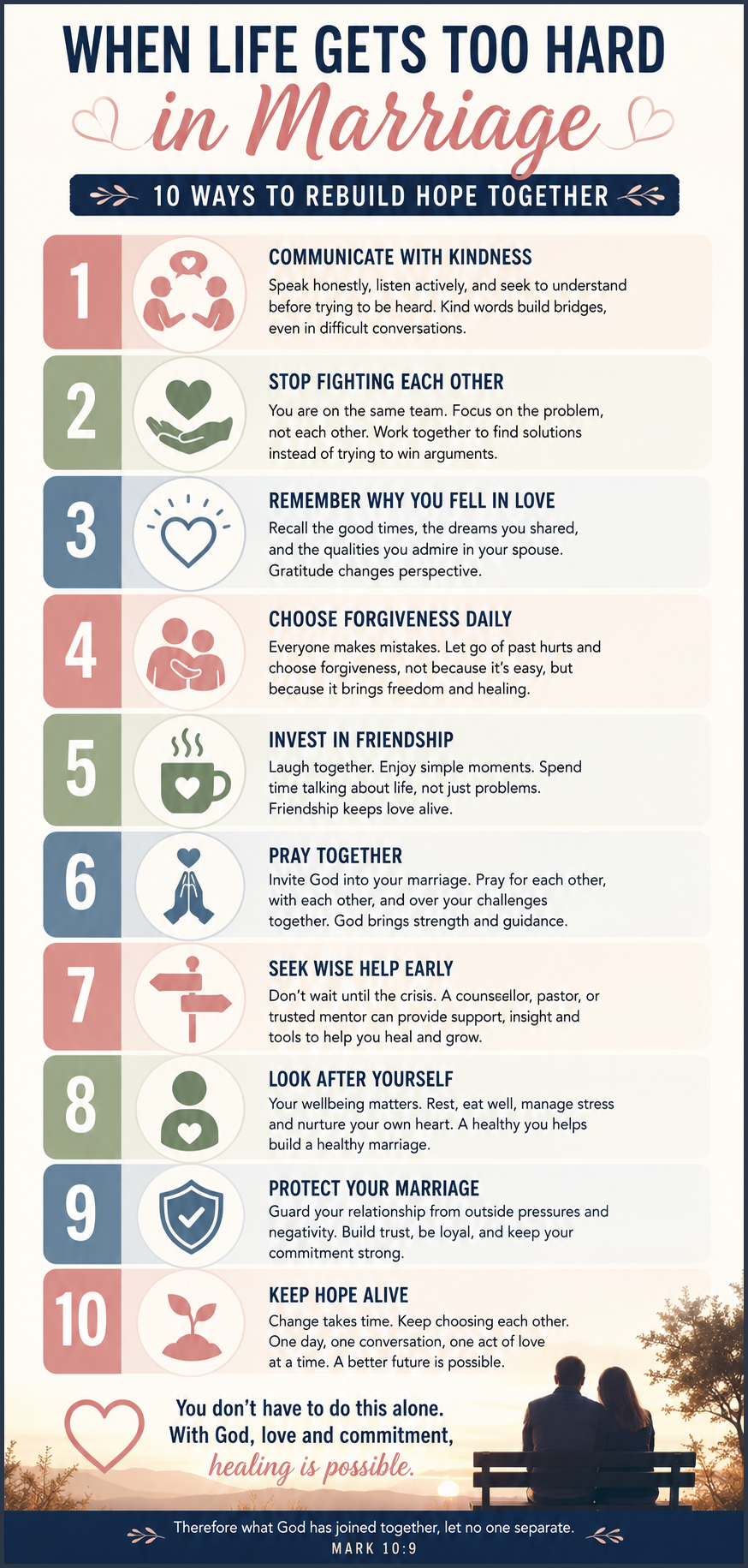
Marriage is one of life’s greatest blessings, but it can also become one of its greatest challenges. Every couple begins with hope. They dream of growing old together, sharing laughter, raising a family, supporting one another through life’s ups and downs, and creating a lifetime of treasured memories.
Yet reality often looks different.
Financial pressure, illness, children, work demands, misunderstandings, disappointment, personality differences, and simply the stresses of everyday life can slowly place strain on even the strongest relationship.
If your marriage feels difficult right now, you are certainly not alone.
Many happy marriages have passed through seasons where both husband and wife wondered whether things would ever improve. The encouraging news is that difficult seasons do not have to become permanent seasons.
With patience, commitment, humility and a willingness to work together, many marriages become stronger after surviving hardship than they ever were before.
If your marriage feels overwhelming today, don’t assume today’s difficulties will define tomorrow.
They won’t.
When Life Gets Too Hard in Marriage:
Every Marriage Has Difficult Seasons
One of the biggest misconceptions about marriage is that successful couples never struggle.
Nothing could be further from the truth.
Strong marriages are not built because two perfect people found each other.
They are built because two imperfect people keep choosing each other.
Every marriage experiences periods of:
- Poor communication
- Stress and exhaustion
- Financial worries
- Parenting disagreements
- Health problems
- Career pressures
- Different expectations
- Emotional distance
- Disappointment
- Personal struggles
These seasons are not necessarily signs that the marriage has failed.
They are opportunities for growth.
Just as muscles become stronger through resistance, relationships often become stronger by working through challenges together.
When Life Gets Too Hard in Marriage:
Stop Seeing Each Other as the Enemy
When marriages become difficult, it is easy to fall into an unhealthy pattern.
Instead of facing the problem together, husband and wife begin facing each other.
Arguments become competitions.
Conversations become battles.
Someone has to win.
Someone has to lose.
But marriage isn’t a courtroom.
It is a partnership.
The real enemy is not your spouse.
The enemy is the problem standing between you.
Imagine standing side by side looking at the problem together rather than standing opposite each other pointing fingers.
That simple change in perspective often changes everything.
When Life Gets Too Hard in Marriage, instead of asking,
“How can I prove I’m right?”
Ask, “How can we solve this together?”
Learn to Listen Before Trying to Be Heard
Most arguments aren’t caused because people refuse to speak.
They’re caused because people refuse to listen.
Many of us spend conversations preparing our next response instead of genuinely trying to understand what the other person is feeling.
Listening doesn’t always mean agreeing.
It means valuing.
Sometimes your husband or wife simply wants to know:
“Do you hear me.”
“Do you understand why I feel this way.”
“Do my feelings matter to you.”
Those simple gifts often calm situations far more effectively than clever arguments ever will.
Small Problems Become Big Problems When Ignored
A dripping tap seems insignificant.
Ignore it long enough and the water damage becomes expensive.
Marriage works much the same way.
Small hurts become resentments.
Minor misunderstandings become ongoing conflict.
Unspoken disappointments quietly accumulate until one day someone says,
“I’ve had enough.”
Don’t allow little problems to become major ones.
Address them kindly.
Address them early.
Address them together.
Healthy couples don’t avoid difficult conversations.
They simply learn to have them respectfully.
When Life Gets Too Hard in Marriage,
Choose Kindness Even When You Feel Hurt
One of the greatest tests of character is how we respond when we’re disappointed.
Anyone can be kind when life is easy.
Real love shows itself when emotions are running high.
Before speaking, ask yourself:
- Will these words heal or hurt?
- Will they build trust or destroy it?
- Am I trying to solve the problem—or win the argument?
Words spoken in anger often leave scars that remain long after the argument has ended.
Gentle words, however, have remarkable healing power.
Kindness is never weakness.
It is strength under control.
Remember Why You Fell in Love
During difficult seasons it’s surprisingly easy to forget everything that first drew you together.
Instead of focusing only on frustrations, deliberately remember:
- What first attracted you?
- What qualities did you admire?
- What made you laugh together?
- What dreams did you once share?
- What sacrifices has your spouse made for you?
Gratitude changes perspective.
The person irritating you today is often the same person who once made your heart race.
Those good qualities have probably not disappeared.
They have simply become hidden beneath the pressures of life.
Don’t Compare Your Marriage with Others
Social media has created unrealistic expectations.
We see anniversary holidays.
Perfect family photos.
Romantic dinners.
Smiling couples.
But photographs rarely reveal reality.
Every marriage has private struggles.
Some simply hide them better.
Focus on improving your own relationship rather than measuring it against someone else’s.
The only marriage you need to strengthen is your own.
Forgiveness Is a Daily Choice
Every successful marriage is built upon forgiveness.
Not because terrible things happen every day.
But because small mistakes happen every day.
We forget things.
We become impatient.
We misunderstand.
We say things poorly.
We make poor decisions.
If every mistake remained permanently on the emotional scoreboard, no marriage would survive.
Forgiveness does not always erase consequences.
Nor does it mean pretending nothing happened.
It simply means choosing not to allow yesterday’s mistakes to control tomorrow’s relationship.
Sometimes forgiveness happens once.
Sometimes it is a decision renewed every morning.
Invest in Your Friendship
Romance may begin a marriage.
Friendship sustains it.
Ask yourself:
When was the last time we laughed together?
When was the last time we enjoyed each other’s company without discussing problems?
When was the last time we simply spent uninterrupted time together?
Life becomes busy.
Children need attention.
Work demands increase.
Bills arrive.
Schedules fill.
Yet relationships flourish when couples continue investing in simple friendship.
Go for a walk.
Share a coffee.
Cook together.
Watch the sunset.
Play a game.
Talk without distractions.
Many marriages don’t need dramatic change.
They simply need regular connection.
When Life Gets Too Hard in Marriage,
Ask for Help Before the Crisis Hits
There is no shame in asking for help.
People willingly consult mechanics for their cars.
Doctors for their health.
Accountants for their finances.
Yet many couples wait until their marriage is falling apart before seeking wise advice.
Strong people ask for help.
Weak pride often refuses it.
A trusted counsellor, pastor, mentor or experienced married couple may provide fresh perspectives that neither spouse can currently see.
Seeking help is not admitting failure.
It is investing in success.
Look After Yourself Too
Marriage involves two people.
If one person is exhausted, overwhelmed, anxious or emotionally depleted, the relationship naturally feels the strain.
Healthy marriages benefit when each partner also cares for their own wellbeing.
That includes:
- Getting enough sleep
- Looking after physical health
- Managing stress
- Spending time in prayer or quiet reflection
- Maintaining healthy friendships
- Pursuing positive interests
You cannot continually pour from an empty cup.
Looking after yourself isn’t selfish.
It enables you to love others more effectively.
When Trust Has Been Broken
Some marriages experience deeper wounds.
Broken promises.
Addiction.
Financial dishonesty.
Emotional betrayal.
Infidelity.
These situations require more than simply “trying harder.”
Healing is possible, but rebuilding trust usually takes time, honesty, genuine repentance and consistent actions rather than promises alone.
Professional counselling is often invaluable during these circumstances.
While not every marriage can or should continue in every situation, many couples have rebuilt relationships that once seemed impossible to repair.
Never underestimate what sincere commitment, accountability and time can accomplish.
When Safety Comes First
Most of the challenges discussed in this article involve ordinary marital difficulties—poor communication, financial stress, disagreements, disappointment and emotional distance. While these problems can be painful, they are very different from domestic violence.
If your relationship involves physical violence, threats of violence, coercive control, or behaviour that causes you to fear for your safety or the safety of your children, your first priority must be protection, not preserving appearances.
No one should remain in a situation where there is a genuine risk of serious injury or death.
Seeking safety is not a failure of faith or a lack of commitment to your marriage. It is a wise and responsible response to a dangerous situation. If necessary, leave immediately and seek help from trusted family members, close friends, your pastor, a domestic violence support service, or the police.
Sometimes an abusive partner genuinely changes, accepts responsibility, and seeks professional help. Reconciliation may be possible in some circumstances, but it should never be rushed or attempted while violence or intimidation continues. Real change is demonstrated over time through consistent actions, accountability and respect—not simply promises or apologies.
If you are living with domestic violence, remember this: your life has value, your children’s lives have value, and your safety matters. There is hope, and there are people and organisations ready to help you take the next safe step.
A period of separation for safety is not necessarily the end of a marriage. In some cases, it provides the secure environment needed for genuine repentance, professional intervention, healing and, where appropriate, reconciliation. But Reconciliation should only be considered when it can be pursued safely and when lasting change has been clearly demonstrated.
The Importance of Grace When Life Gets Too Hard in Marriage
Every person enters marriage carrying weaknesses.
Nobody marries a perfect husband.
Nobody marries a perfect wife.
Eventually our flaws become visible.
Grace means recognising that your spouse is still growing.
Just as you are.
Healthy marriages become places where people feel safe enough to admit mistakes without fear of constant condemnation.
Grace creates room for growth.
Criticism rarely does.
Hope Is Stronger Than Despair
Perhaps today your marriage feels distant.
Maybe conversations have become awkward.
Perhaps you’ve stopped laughing together.
Maybe you’re wondering whether things can ever improve.
The answer is yes.
Not because change is easy.
But because people change.
Relationships change.
Hearts soften.
Understanding grows.
New habits develop.
Thousands of couples who once believed their marriage was finished now enjoy healthy, joyful relationships because they refused to give up during their darkest season.
The difficult chapter you’re living today does not have to become the final chapter.
A Biblical Perspective on Marriage
The Bible describes marriage as a covenant built on love, commitment and mutual care.
The Apostle Paul encourages husbands and wives to treat one another with sacrificial love, patience, kindness and forgiveness.
Colossians 3:13 reminds us:
“Bear with each other and forgive one another if any of you has a grievance against someone. Forgive as the Lord forgave you.”
Likewise, 1 Corinthians 13 paints a timeless picture of genuine love:
“Love is patient, love is kind… It always protects, always trusts, always hopes, always perseveres.”
These words are not merely poetic.
They are practical.
Every one of these qualities strengthens a marriage.
Every one brings healing where relationships have become strained.
Final Thoughts
Every marriage will encounter storms.
That is unavoidable.
What matters is not whether storms come, but how we respond when they arrive.
Choose patience over impatience.
Choose understanding over accusation.
Choose forgiveness over resentment.
Choose hope over despair.
Most importantly, choose each other again.
One conversation.
One act of kindness.
One apology.
One prayer.
One day at a time.
Small, faithful choices made consistently often transform marriages more powerfully than dramatic gestures.
If your marriage is struggling today, don’t lose hope.
Many of the happiest couples you know have quietly walked through seasons just like yours.
They simply refused to stop believing that tomorrow could be better.
And perhaps that is exactly where your own new beginning starts.
Thank you for Reading our Article on “When Life Gets Too Hard in Marriage”