When Life Gets Too Hard Because of Illness
Illness can change your life in a moment—or slowly reshape it over months or years. Whether the illness is temporary, chronic, or life-threatening, it affects far more than the body. It challenges your emotions, your relationships, your finances, your plans, and sometimes even your hope. Yet countless people have discovered that while illness may change the course of life, it does not have to define the quality of life.
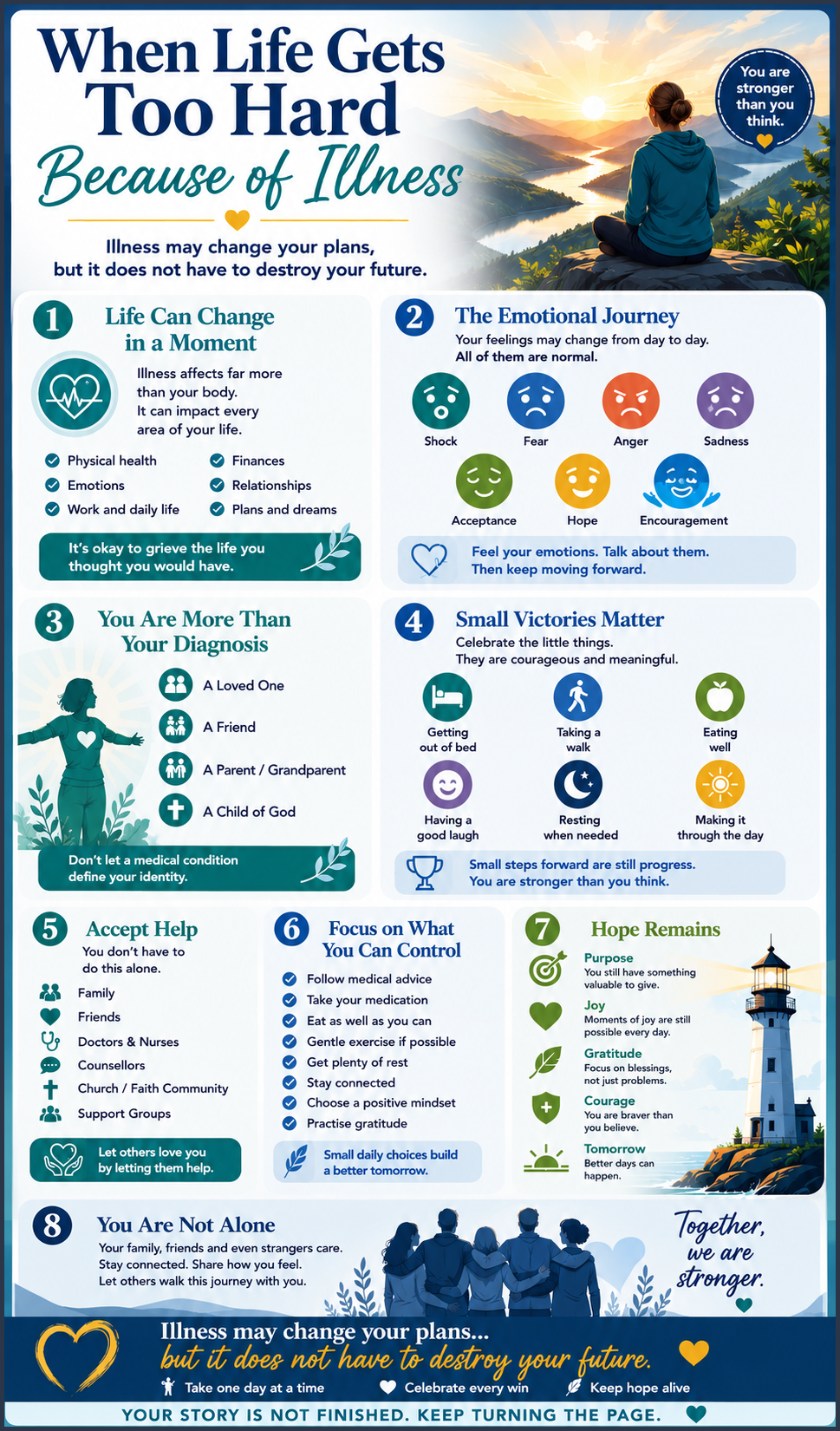
When Everything Changes Because of Illness
Most of us assume tomorrow will be much like today.
We make plans. We organise holidays. We think about work, family, retirement, or the next stage of life.
Then illness arrives.
Sometimes it comes suddenly—a heart attack, stroke, accident, or unexpected diagnosis.
Other times it creeps in quietly. Persistent pain. Increasing fatigue. A condition that slowly limits what was once easy.
Regardless of how it begins, illness often brings an overwhelming question:
“Why me?”
It is one of the most natural questions anyone can ask.
You may never receive a complete answer.
But you can still discover a meaningful way forward.
Illness Changes More Than Your Health
People often think illness is simply about physical symptoms.
In reality, it affects almost every area of life.
You may experience:
- Loss of independence
- Financial pressure
- Changes to employment
- Anxiety about the future
- Depression or loneliness
- Strained relationships
- Interrupted dreams
- Fear of becoming a burden
- Frustration over things you can no longer do
Many people also grieve the loss of the person they used to be.
That grief is real. Allow yourself to acknowledge it rather than pretending everything is fine.
Acceptance is not giving up.
Acceptance is recognising reality so you can move forward from where you are today.
The Emotional Roller Coaster
Living with illness is rarely emotionally predictable.
One day you feel optimistic.
The next day you may feel exhausted, discouraged, or angry.
These changing emotions are normal.
Many people cycle through feelings such as:
- Shock
- Denial
- Fear
- Anger
- Sadness
- Acceptance
- Hope
- Encouragement
You do not have to feel guilty for experiencing these emotions.
They simply remind you that you are human.
The important thing is not whether difficult emotions appear—it is whether they become permanent residents.
Feel them.
Talk about them.
Notice the Gradual Improvement.
Then keep moving forward.
Avoid Fighting Tomorrow’s Battles Today
One of the greatest burdens illness creates is uncertainty.
Questions begin multiplying.
Will the treatment work?
Will I recover?
Will I lose my job?
Will my family cope?
How long will this last?
The mind naturally races toward the worst possible outcomes.
Unfortunately, those imagined futures often cause more suffering than today’s actual reality.
Instead of trying to solve every possible future problem, focus on today’s needs.
Ask yourself:
- What do I need today?
- What appointment is next?
- What decision actually needs making now?
- What small victory can I celebrate today?
Life becomes far more manageable when we stop carrying tomorrow before it arrives.
You Are More Than Your Diagnosis
One of the greatest dangers of long-term illness is allowing it to become your identity.
People stop asking:
“What do you enjoy?”
Instead they ask:
“How are you feeling?”
Gradually, life becomes centred around appointments, medications, test results and symptoms.
But illness is something you have.
It is not who you are.
You are still:
- A husband or wife
- A parent
- A grandparent
- A friend
- An artist
- A gardener
- A musician
- A volunteer
- A problem solver
- Someone with dreams and purpose
Never allow a medical condition to erase everything else that makes you uniquely you.
When Going Through Illness, Small Victories Matter
When healthy, we often measure success by large achievements.
Promotions.
Holidays.
Major purchases.
Big goals.
Illness teaches a different way of measuring success.
Sometimes success means:
Getting out of bed.
Walking to the mailbox.
Preparing a meal.
Attending an appointment.
Enjoying a laugh.
Sleeping well.
Making it through another difficult day.
These victories may seem small to others.
They are not small.
They represent courage.
Never underestimate what you have overcome simply because someone else cannot see the battle.
Accept Help Without Feeling Weak
Many independent people struggle to accept assistance.
They have spent decades helping everyone else.
Now the roles have changed.
That can feel uncomfortable.
Remember this.
If someone you loved became ill, would you want to help them?
Of course you would.
Helping others is one of the deepest expressions of love.
Allowing others to help you gives them that same opportunity.
Receiving help is not weakness.
It is simply recognising that none of us were designed to face life’s hardest moments alone.
Stay Connected
Illness often creates isolation.
People stop visiting.
Friends become unsure what to say.
You may withdraw because you do not want others to see your struggles.
Unfortunately, isolation usually makes emotional pain worse.
Even brief conversations can make an enormous difference.
Stay connected through:
- Family
- Friends
- Community groups
- Church
- Support groups
- Telephone calls
- Video chats
- Social activities when possible
Human connection remains one of life’s greatest medicines.
Look After Your Mental Health
Physical illness and mental health are closely connected.
Long-term pain, ongoing treatment, limited mobility, and uncertainty can all affect emotional wellbeing.
There is absolutely no shame in asking for professional support.
Counsellors.
Psychologists.
Support groups.
Mental health plans.
Trusted friends.
Pastors.
Doctors.
Each may play an important role.
Strength is not pretending everything is fine.
Strength is seeking help before becoming overwhelmed.
Focus on What You Can Control
Illness removes many choices.
But not all of them.
You may not control your diagnosis.
You can control:
- Following medical advice
- Eating as well as possible
- Gentle exercise if appropriate
- Taking medication correctly
- Maintaining friendships
- Practising gratitude
- Resting when needed
- Choosing hope over despair
These daily choices often become powerful foundations for recovery—or for living well despite ongoing illness.
Purpose Is Still Possible
Many remarkable people have made their greatest contribution while living with illness or disability.
Some became writers.
Others encouraged fellow patients.
Some volunteered.
Some mentored younger people.
Some simply became extraordinary listeners because suffering had taught them compassion.
Purpose rarely disappears.
Sometimes it simply changes direction.
Ask yourself:
“What can I still give?”
Your answer may surprise you.
Hope Does Not Require Certainty
People often think hope depends upon guaranteed outcomes.
It does not.
Hope simply believes tomorrow may contain something worth living for.
A better treatment.
A good conversation.
Less pain.
A beautiful sunrise.
A grandchild’s smile.
A new friendship.
An unexpected breakthrough.
Even on difficult days, life continues offering moments worth experiencing.
Hope keeps us looking for them.
Celebrate Every Good Day
When living with illness, good days become precious.
Do not waste them.
If you feel stronger today:
Go for a walk.
Visit the beach.
See friends.
Read a book.
Watch the sunset.
Take photographs.
Laugh often.
Create memories.
No one knows how many good days lie ahead.
Treat each one as a gift.
Don’t Compare Your Journey
Comparison steals hope.
Someone else may recover faster.
Someone else’s treatment may work better.
Someone else may appear stronger.
Their journey is not yours.
Every illness is different.
Every body responds differently.
Every life story is unique.
Judge your progress only against where you were yesterday.
Even tiny improvements deserve celebration.
Your Family Is Also Walking This Journey
Illness rarely affects only one person.
Partners become carers.
Children become worried.
Parents feel helpless.
Friends often carry silent concerns.
Remember to communicate honestly.
Allow loved ones to express their own fears.
Sometimes families become stronger because they learn to support one another in ways they never imagined possible.
Hard seasons often reveal just how deeply people care.
There Is Still Joy to Be Found
Joy and illness CAN exist together.
That may sound impossible.
Yet many people living with chronic conditions describe moments of profound happiness.
A child’s hug.
A favourite meal.
Birdsong outside the window.
A phone call from an old friend.
A beautiful garden.
Music.
Prayer.
Kindness from strangers.
Illness changes what brings joy.
It does not eliminate joy itself.
Sometimes it actually helps us notice the simple blessings we once took for-granted.
Life May Be Different—But Different Is Not Always Worse
Most of us would never choose illness.
Yet many people later say it taught them lessons they could have learned no other way.
Greater patience.
Deeper compassion.
Stronger relationships.
Clearer priorities.
A renewed appreciation for life.
Less concern about material things.
More gratitude for ordinary moments.
No one wishes for suffering.
But many discover unexpected strength because of it.
Final Thoughts
If you are facing illness today, know this:
You are not weak.
You are not failing.
You are fighting a battle that many people cannot see.
Some days your greatest achievement may simply be getting through the day.
That is enough.
Take one step.
Then another.
Lean on those who care about you.
Accept help when it is offered.
Celebrate every small victory.
Look for moments of joy.
Believe that your life still has purpose.
Illness may change your plans, but it does not have to destroy your future.
Many people have discovered that even in life’s hardest seasons, courage grows quietly, hope returns unexpectedly, and strength appears one day at a time.
Your story is not finished.
Keep turning the page.
The next chapter may hold more hope than you can see today.
Thank You for visiting our page on When Life Gets Too Hard Because of Illness !